For schools

A structured space to explore who they want to be

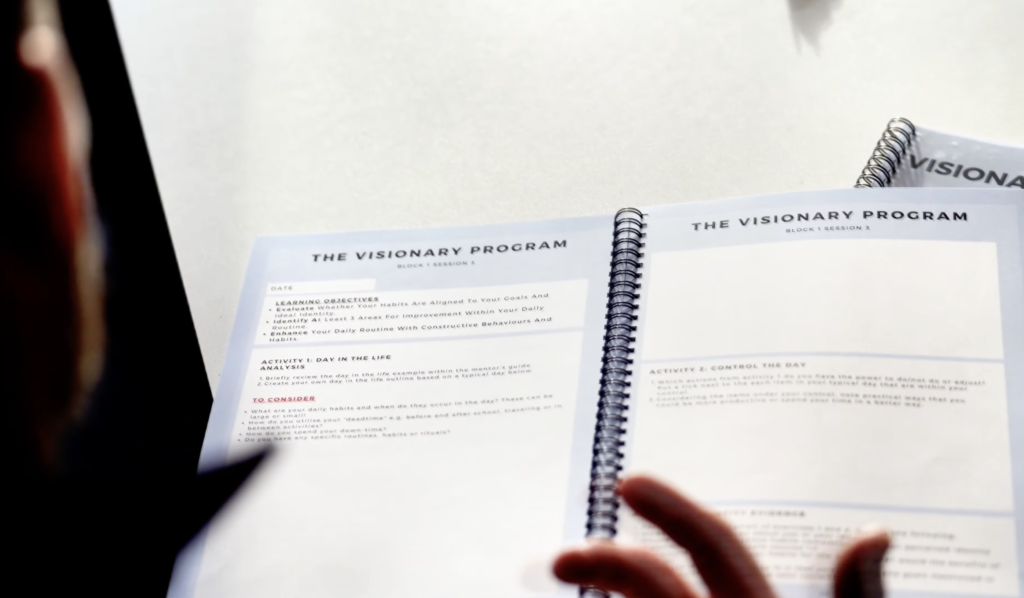
Small-group mentoring in your school, where pupils examine who they are, picture who they want to become, and set their own goals. One hour a week, six weeks a term, with a personal workbook for each pupil.
What it is

A mentor they want to listen to, asking questions that engage them

Pupils meet in small groups with a mentor, once a week, in your school. Sessions combine guided conversation, written reflection in a personal workbook, and time on court where you have the space and it helps.
The pupils choose the goals. We supply the questions, the structure and the follow-up: they examine the beliefs they arrived with, picture something bigger than their current circumstances, and build the habits that close the distance.
It is not an assembly, and it is not us coming in to tell our stories. It is a curriculum, with learning objectives and defined outcomes, and pupils start to become the authors of their own journeys.

The Visionary process begins with self-awareness. You have to look inward before you can look forward.

From the Visionary curriculum
Beyond the sessions

Something they can point to for years

Every pupil who completes the programme receives a certificate of completion. The real value is the experience behind it: a structured course in self-reflection, goal-setting and leadership they have genuinely been through, not just heard about in an assembly.
That gives them something specific to write about in a personal statement, a UCAS application, a CV or a job application, and evidence they have worked on the intangible skills those forms ask for. It is not a formal qualification, but it is a real experience they can speak to in their own words.

A certificate of completion

Every pupil who finishes the programme receives one.

Something to write about

A concrete experience for a personal statement, a UCAS form, a CV or an application.

Evidence of the intangibles

Proof they have worked on self-reflection, discipline and leadership in a structured way, not just claimed them.

The Visionary Process

Three domains in sequence. Two that never stop.

01

SEE Yourself Clearly

Who are you today, and where did those beliefs come from? Pupils map their own story, compare the labels they give themselves against the labels others give them, trace how a thought becomes a feeling and a feeling becomes an action, and find the point in that chain they control.

02

Become a VISIONARY

Name the limiting beliefs, then take them apart. Guided visualisation builds a picture of who a pupil could become, specific enough to walk into, and they work out what it would take to be that person.

03

ENHANCE Your Focus

A vision without a system is a wish. Goals are made specific, broken into habits and tracked, with the obstacles named and planned for in advance.

Running through all three
The work

The Visionary Toolkit

Practical tools handed over as they are needed: organisation, distraction, environment, study, time management, wellbeing and mastery.
The hard work

Visionary Mindset

Resilience, discipline, and the Visionary Reset: what to do in the moment when it isn’t working.
The detail

How it works in practice

How it runs is yours to shape. Most schools slot us into an enrichment block; you choose the focus, the year group and the pupils, and we build around the targets you set, with you and often with the pupils themselves.
What we go deep on shifts with age. With younger year groups the work is mostly self-awareness: who they are, and how they see themselves. With pupils heading towards sixth form, college or university it turns to grounding: how they make decisions, what they actually want, and the tangible steps and resources that make that next transition easier.
Our mentors have been there. They know what it is to be a student athlete, to juggle several hats at once, to perform under pressure, to move to a new city or country and start again. They come from academic and sporting backgrounds alike, and they draw on all of it to help a young person get where they want to go.

01

Stated learning objectives

Stated learning objectives

Every session opens with what a pupil should be able to do by the end of it, and closes against outcomes we hold ourselves to.

02

A written Mentor Guide

A written Mentor Guide

Mentors work from the same guide and the same glossary of terms, so one group gets the same programme as another.

03

A personal workbook

A personal workbook

The questions are ours. The answers are theirs, written down and revisited as the block runs.
In a school

What it looks like on the day

Impact

What people say about us

“One student in particular grew in confidence, started attending lessons on time and engaging with teachers and her peers. This also had a positive outcome at home. Other students learnt to work together, engage with others and trust adults.”

Tara Webster

Senior Leadership Team, Redland Green School

“It has been really working for getting kids to open up… you can see the input the mentors have had in the progress the students are making.”

Staff feedback

Excalibur Academies Trust

4.75/5

Average school rating across rapport, organisation, basketball engagement and pupil engagement

4.94/5

Caledonia Blues academy players’ rating for engagement and delivery
Schools, clubs and organisations we have worked with
Item 1
Item 2
Item 3
Item 4
Item 5
Item 6
Default Title

Not sure which format fits your year group?

That is exactly what the first call is for. Twenty minutes, no commitment.
Working together

What it takes from you

Four steps, from the first conversation to the feedback at the end.

01

A conversation first

A conversation first

What is going on with the year group, which pupils you have in mind, and what you would want to see change.

02

Agreed logistics

Agreed logistics

We agree the logistics and a format you think will land for your pupils, then set it out in a written agreement, safeguarding arrangements included, linked into your school’s existing procedures.

03

Delivery in school

Delivery in school

Mentors run the sessions: guided conversation, a personal workbook, and court time where it helps.

04

Feedback we act on

Feedback we act on

Pupils, staff and our mentors all feed back as the block runs. We use it to improve the programme as we go, and we take any concern seriously, straight away.
Choosing the cohort

Who goes in the room

You choose who takes part. You know your pupils, and we build the programme around whoever you put in the room.
It isn’t only for the pupils already on your radar. Some of the biggest shifts come from the capable, well-liked ones who are quietly coasting: nothing about them flags an intervention, so nothing reaches them. And it works just as well for a whole year group facing a transition, a single form, or a specific cohort you have in mind.
If there are pupils your pastoral team is already supporting, we’re glad to include them where that’s agreed in advance. We’ll talk any cohort through with you first, so it’s the right fit.

Works well for

Pupils with ambition and no route, pupils who have gone quiet, and year groups facing a transition: options, GCSEs, post-16.

The right fit

Where a young person needs specialist or clinical support, we’ll say so and help point you to the right route. That honesty is part of how we work.

Gifted and talented

Not only for pupils who are drifting. Gifted and talented young people looking for an edge, the push from good to great, get just as much from it.

Safeguarding

How we keep young people safe

Our programme asks young people to be honest about themselves. That takes clear boundaries, adults who have been properly vetted, and the reassurance that what they share is treated with care and respect.

Vetted and trained

Every mentor comes with an enhanced DBS, safeguarding training, and in-house mentoring training built for the age group they work with.

Teacher or TA always present

A teacher or teaching assistant is present throughout every school session.

Raising a concern

Concerns go to our own Level 3 Designated Safeguarding Lead and your school’s DSL, worked through your routes so nothing is missed.

Get in touch

Bring Visionary Mentoring to your school

Tell us the year group and what you want to change. Twenty minutes on a call and we will tell you what we would run, what it would cost, and whether we are the right fit.